Water coming through the ceiling? The emergency line is answered by a person, 24 hours a day, every day of the year — we tarp and make safe first, and estimate in daylight. Call 000-000-0000
The physics is simple and almost universally ignored. Air enters low at the soffits, warms, rises, and leaves high at the ridge. That flow removes heat in summer and moisture in winter. It requires openings at both ends in roughly equal area — and if either end is missing or blocked, the whole system does nothing whatsoever.
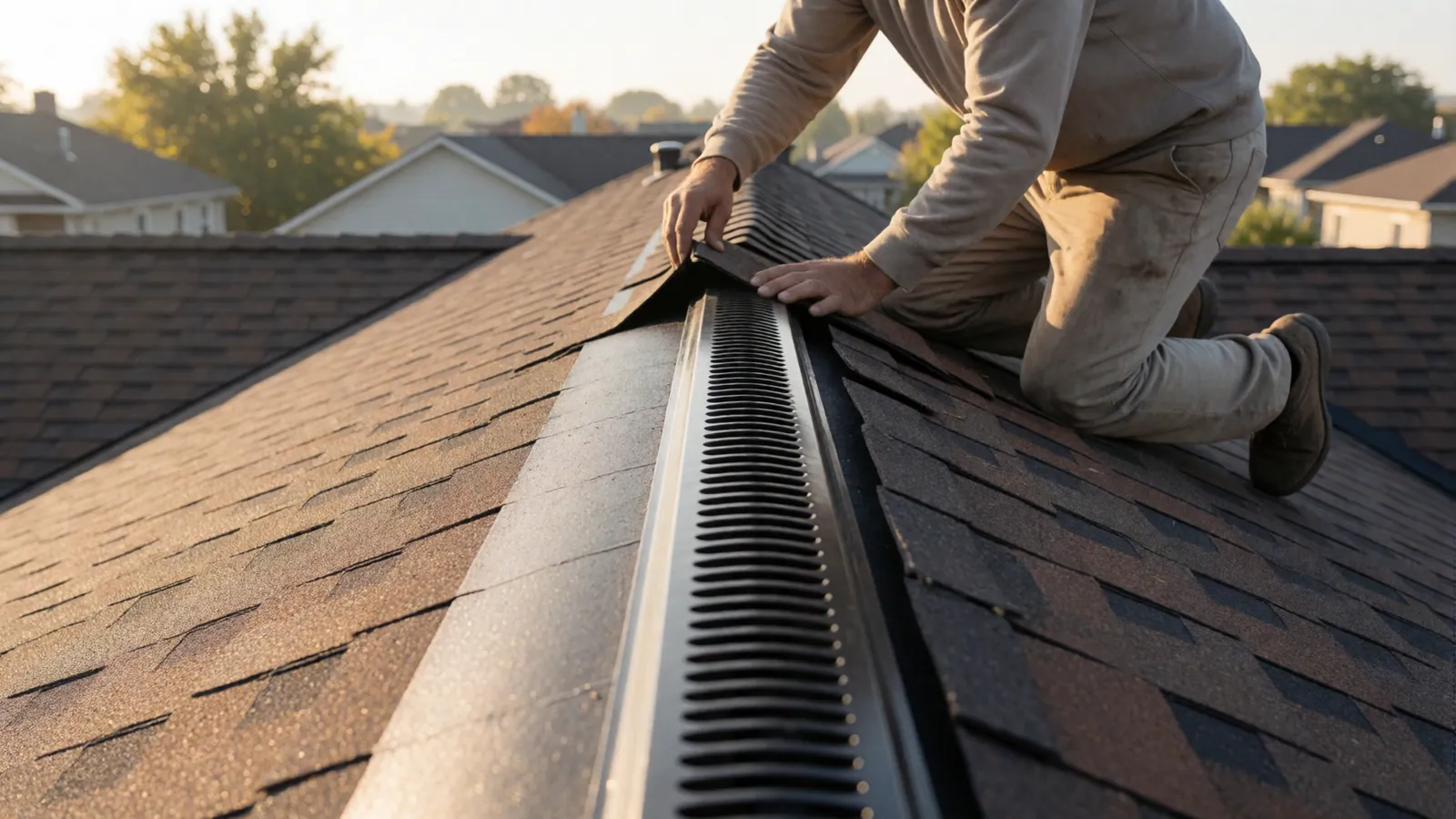
What we find on Queens houses, over and over, is exhaust with no intake. A ridge vent installed on a re-roof, soffits that were never perforated or have been packed solid with insulation, and consequently an attic with no airflow at all. The homeowner has paid for ventilation and does not have any. It is invisible from every angle, which is exactly why it persists.
What ventilation actually does
Four separate benefits, and only one of them is about comfort.
Extends roof life
Asphalt shingle degrades with heat. An attic at 150°F is cooking the underside of the roof all summer. Balanced ventilation routinely adds years to a shingle roof — and its absence is a condition that voids most manufacturers' warranties.
Prevents ice dams
An ice dam forms when heat escaping into the attic melts snow on the upper roof, which then refreezes at the cold eave. Water backs up behind the ice and runs uphill under the shingles. Ventilation and insulation keep the roof deck cold, so the snow does not melt in the first place.
Removes winter moisture
A household produces a remarkable quantity of water vapour. It rises into the attic, meets a cold deck and condenses — frost in January, drips in February, and a rotting deck over several years. It looks exactly like a leak and it is not one.
Reduces cooling load
A ventilated attic runs far cooler, so less heat is driven down into the rooms below. On an occupied top floor the difference in August is genuinely noticeable.
What we install
Intake and exhaust, sized against each other. The rule of thumb is one square foot of net free vent area per 150 square feet of attic floor, split roughly evenly between the two.
Continuous ridge vent
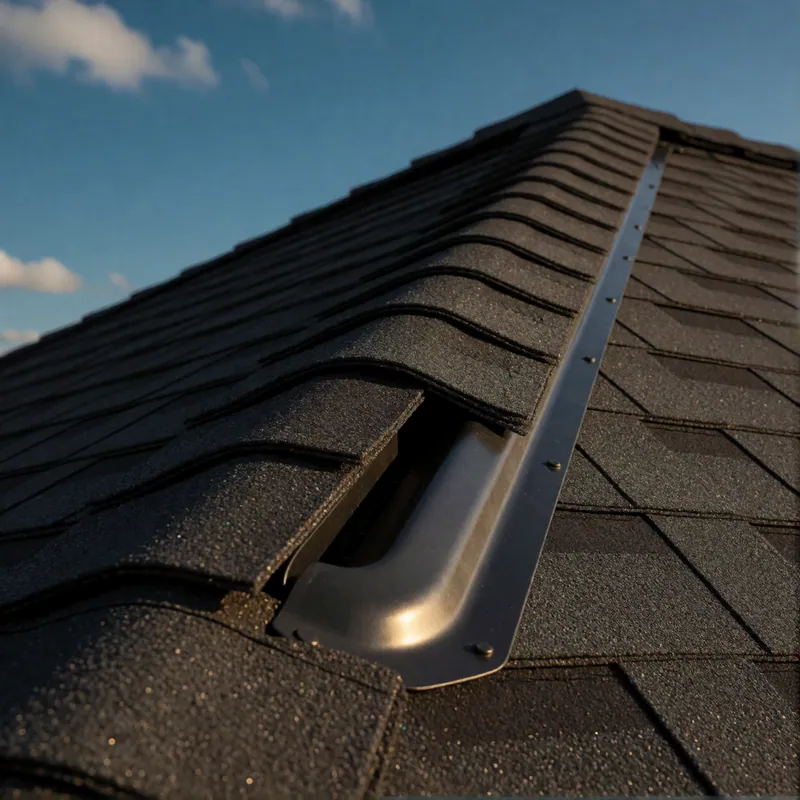
Exhaust along the full ridge, capped with shingle so it disappears. The best exhaust there is, because it is continuous and it works with the natural airflow rather than against it.
Soffit vents
Continuous perforated soffit or individual vents. This is the half that is usually missing, and without it the ridge vent achieves nothing.
Baffles at the eaves
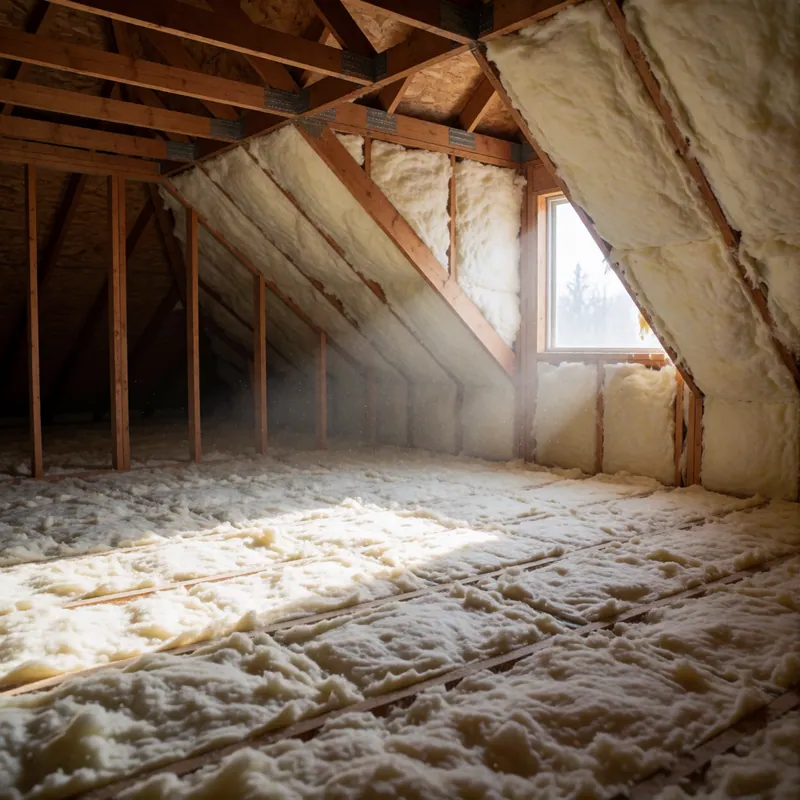
Rigid channels that keep the airflow path open where insulation meets the roof deck. Insulation stuffed into the eave blocks the intake completely — one of the commonest faults we find.
Gable and static vents
Where a roof has no usable ridge, or on a section that cannot be vented conventionally.
Powered and solar fans
Occasionally justified, frequently oversold. A powered fan on an attic with inadequate intake pulls conditioned air out of the house through ceiling gaps. We fit them only where the intake genuinely supports them.
Air sealing the ceiling plane
Recessed lights, hatches, pipe and wiring penetrations. Stopping warm damp air getting into the attic is more effective than trying to ventilate it away afterwards.
Insulation, topped up and corrected
Depth checked, coverage evened out, and kept clear of the eave airflow path. Ventilation and insulation only work as a pair.
Signs your attic is not working
Any one of these is worth an inspection, and most are visible without going up.
Ice dams every winter
The clearest signal there is. Ice at the eaves is a heat problem in the attic, not a roof problem on the roof.
Frost or damp on the underside of the deck
Condensation. Look on a cold clear morning in January — the deck should be dry.
A top floor that is unbearable in summer
Heat accumulating overhead with nowhere to go.
Shingles cupping or curling early
A roof aged prematurely from below.
Insulation packed into the eaves
Blocking the intake completely. Very common where insulation has been added by someone thorough but unfamiliar with roofs.
A ridge vent with no soffit vents
Exhaust with no intake. Look up at the underside of the eaves from the garden — if there are no openings, you have no intake.
Musty smells or mould on stored items
Persistent attic humidity, which is a ventilation and air-sealing problem.
Attic Ventilation & Insulation in western Queens
Balanced intake and exhaust — the single biggest factor in how long a roof lasts, and the reason ice dams form at all.
Every job of this kind starts the same way: somebody climbs it, photographs it, and writes down what is actually wrong before anybody quotes a price. The survey is free, the report is yours, and you are under no obligation to use us for the work it recommends.
Questions
Attic Ventilation & Insulation — the questions we are asked most
How do I stop ice dams forming on my roof?
By keeping the roof deck cold, which means fixing the attic rather than the roof: air-seal the ceiling plane so household heat cannot get up there, insulate to an adequate depth, and ventilate with balanced intake and exhaust so any heat that does escape is carried away. Heated cables and chipping at ice treat the symptom every winter; this treats the cause once.
How much ventilation does my attic need?
The standard rule is one square foot of net free vent area for every 150 square feet of attic floor, split roughly evenly between intake at the soffits and exhaust at the ridge. The split matters as much as the total — exhaust with no intake produces almost no airflow at all, which is by far the most common fault we find.
I have a ridge vent. Is that enough?
Only if you also have soffit vents. A ridge vent without intake is the single most common ventilation fault in Queens, and it is invisible unless someone looks. Stand in the garden and look up at the underside of your eaves: if there are no openings there, your ridge vent is doing very little.
Is there frost in my attic in winter — is that a leak?
No, that is condensation, and it is a ventilation and air-sealing problem. Household moisture rises into the attic, meets the cold underside of the deck and freezes. It melts during a thaw and drips, which is why it gets reported as a roof leak. Untreated it rots the deck over several years.
Do attic fans work?
Sometimes, and they are frequently oversold. A powered fan on an attic with inadequate soffit intake will pull air from the easiest available source, which is the conditioned house below through gaps in the ceiling. That costs you money in summer. Fix the intake first; a fan is worth considering only after that.
Will better ventilation lower my energy bills?
In summer, yes and noticeably — a cooler attic means less heat driven into the rooms below. In winter the bigger saving comes from air-sealing the ceiling plane and adequate insulation; ventilation's winter role is removing moisture rather than saving energy directly.
Can this be done without replacing the roof?
Yes. Soffit vents, baffles, air sealing and insulation are all done from inside or from the eaves and need no roof work at all. Only a ridge vent involves opening the roof, and it is a one-day job. That said, if a re-roof is coming in the next couple of years, the ridge vent is meaningfully cheaper as part of it.
Related
Often needed alongside this

Specialist, Commercial & Systems
Slate & Tile Roofing
Slate, clay and concrete tile repaired and re-laid by people who know that the flashing usually fails fifty years before the slate does.
Read more
Specialist, Commercial & Systems
Skylights & Roof Windows
New skylights, replacements and the re-flashing that fixes the ones leaking now — because it is almost never the glass.
Read more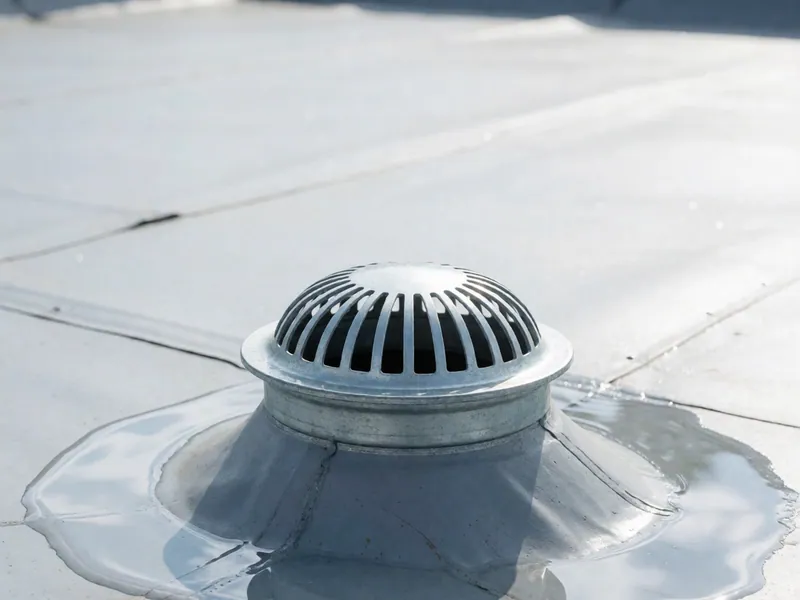
Specialist, Commercial & Systems
Commercial & Multi-Family
Flat roofs on occupied buildings, managed as an asset — surveys, planned maintenance, and work sequenced around tenants.
Read moreFree survey, written quote, fixed price
Get a roof quote, or call the 24-hour line
Tell us what you are seeing and we will tell you honestly whether it needs somebody tonight or whether it will keep until the morning. Surveys and written quotes are free, and leak diagnostics are $145, credited in full against any repair you approve.